How I designed a multifaceted solution for Readlang’s Content Libraries to help learners find high-quality, relevant materials with confidence
Readlang
TIMEFRAME
4 x weeks
TEAM
UX Designer (me)
Software Engineer
ROLE
User and Competitor Research | Data Analysis | Ideation | Wireframing | Prototyping | Stakeholder Relationships
Problem
Content Libraries don’t meet the expectation
Readlang founder (and engineer) Steve wants to elevate the platform’s experience for its loyal user base while attracting new subscribers. After initial research, we settled on the Public Library feature - an area with clear potential but falling short of user expectations.
Design Solution
Encourage community contribution
I designed a multi-faceted solution to improve content quality and discoverability, build user trust, and encourage contributor engagement and accountability.
MULTIPLE WAYS TO REPORT CONTENT ISSUES
This empowers users to flag problems, building trust and providing valuable data for future improvements.
RESTRUCTURED CONTENT UPLOAD PROCESS
By encouraging higher-quality contributions, we could reduce low-value uploads and position Readlang as a source of reliable, high-quality materials.
CONTRIBUTOR DASHBOARD
New dashboard shows contributors how their uploads are performing, motivating them to refine their work.
“I want relevant and high-quality content that is easy to find”
User Insights
After surveying 34 people and 14 user interviews, I learnt that although users loved the idea of the Content Library they avoid it because they struggled to find relevant content and didn’t trust its quality.
They wanted content that felt tailored to their needs and confidence in its reliability. This insight became the foundation for the project.
In order to raise and maintain a high standard of content, we need the community to contribute

Ideation
Give users control
I began by brainstorming solutions that addressed the users’ pain points while keeping in mind the business goals and what’s realistically achievable for the small team.
I kept thinking about what needs to change to make the Content Libraries deliver. How can we ensure good quality content is easy to find?
After a meeting with Steve, I had an idea:
We need the community to contribute to raising and maintaining a high standard of content.
It is NOT about a new design for the library or a different filtering system - it is about giving the users control.
Solution
Less work for the users, contributors and the engineer
1. REPORT CONTENT ISSUES
I designed a new function with multiple opportunities for users to report poor quality content:
Feedback at the end of a session
Reporting midway through a session
A prompt to give feedback if the user abandons a session
These options make it easier to gather and act on data. While Steve prefers to process reports manually for better oversight, I suggested setting up prompts after a certain number of reports are received and recommended actions for communicating with content creators.
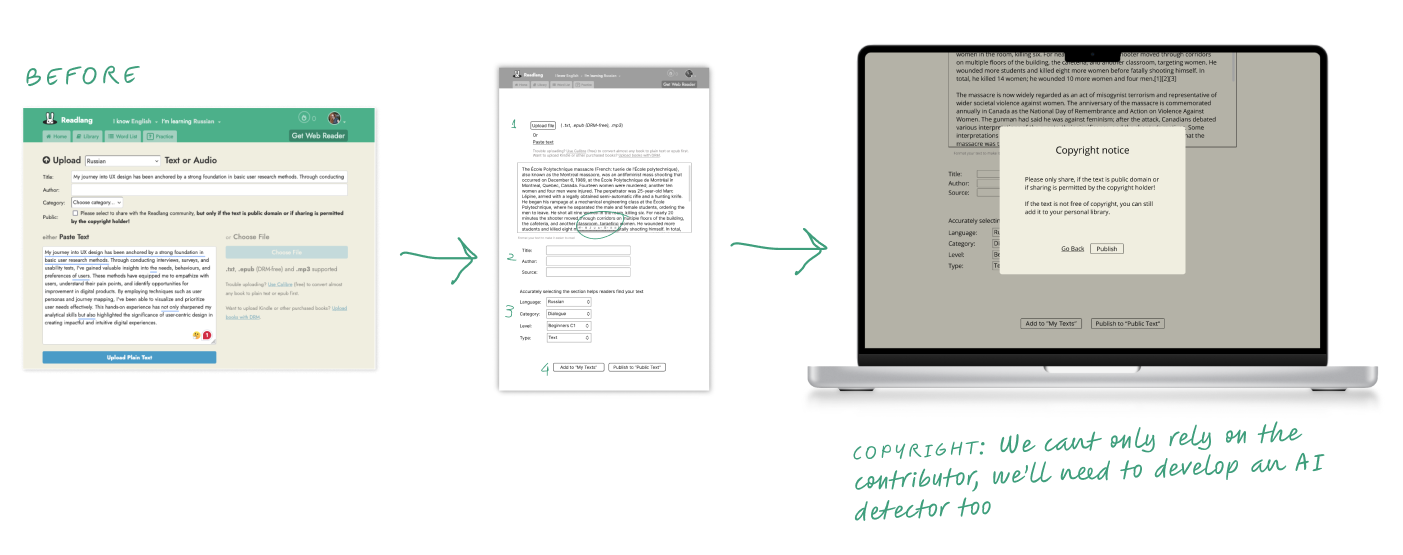
2. CONTENT UPLOAD REDESIGN
I improved the content upload process to enhance clarity and prevent accidental or inappropriate uploads:
Simplified the flow. Replaced the cluttered design with clear, step-by-step guidance.
Improved clarity. Ensured contributors could easily follow each step without confusion.
Improved CTA’s. Made it explicit that users are uploading to the Public Library, reducing accidental uploads of incomplete content.
Added copyright protection. Introduced a confirmation popup to prevent contributors from publishing copyrighted material.
3. CONTRIBUTOR DASHBOARD
A dedicated space for contributors to track their uploads' performance, encouraging them to refine their content.
Performance Insights: Added icons to display key metrics such as likes and read count.
Content Editing: Included an option to edit uploads, making it easier for contributors to improve their work.
Impact
How can Readlang evaluate the success
With a new reporting system, poor quality content will be removed efficiently, while a clearer upload process and improved creator dashboard will encourage higher quality contributions. This will enhance user confidence, improve engagement and reduce moderation workload.
Once these changes are implemented, I’ll track the impact through key metrics, including:
Increased content engagement (clicks, saves, completions)
Fewer flagged content reports due to poor quality
Higher contributor engagement and retention
Monthly report submissions and percentage leading to content updates or removals
Fewer abandoned content that fail to meet expectations
Growth in high quality content (measured by engagement and ratings)
Improved user trust and satisfaction with content (via surveys)
Let’s chat about your project.
If you’re working through a problem or shaping something new, I’d love to talk.